
History, Warm and Cold

I was at a conference in Providence last week and forgot to pack a jacket, which made me a little more attentive to the wind and sunlight of New England, and to the increasingly bare branches of the trees.
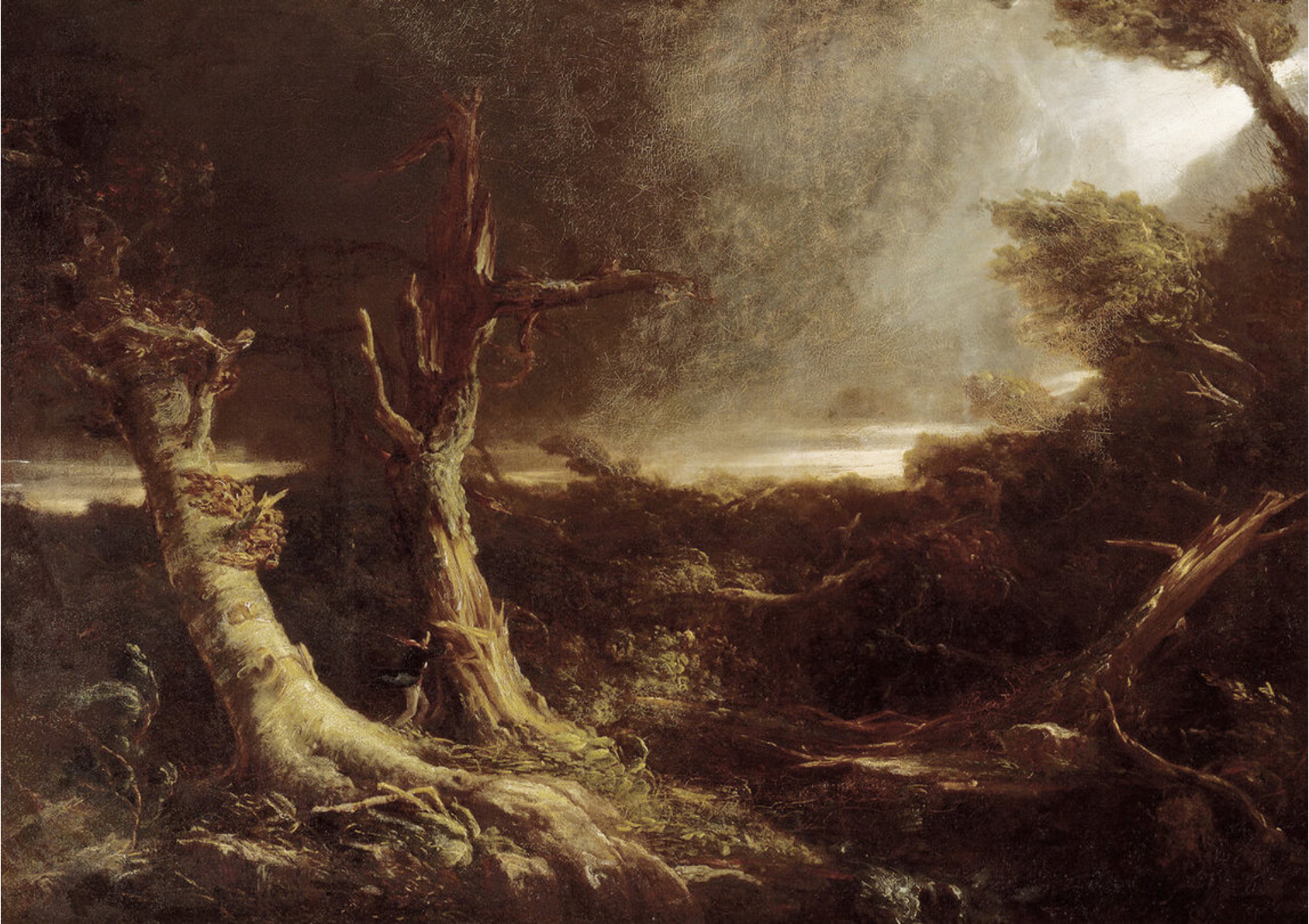
Thomas Cole, “Tornado in an American Forest” (1831)
The best presentation at the conference was the very first one I saw: Sherman Dorn examined the material culture of “merit” in nineteenth century schools, particularly the tickets and certificates that teachers awarded their pupils. His primary argument was that (pace existing historical accounts) merit was not necessarily competitive but instead a recognition of individual competency, effort, and moral probity (think of merit badges in scouting). The distinction is an important one, and it continues to inform debates over proficiency benchmarks in state curricular standards and the National Assessment of Educational Progress. The part of the presentation that I found most interesting, however, was that some of the certificates were not merely printed and cut out but handwritten, inscribed with dedications, and tenderly illustrated. (Sorry for the low-quality images; I just had my phone…) Here, merit was not only a non-competitive recognition of academic skills and habits but an expression of emotional warmth and humanity between teachers and students. The artifacts capture a deeply sentimental aspect of education, and readers of this blog know that, for me, “sentimental” is rarely an epithet.
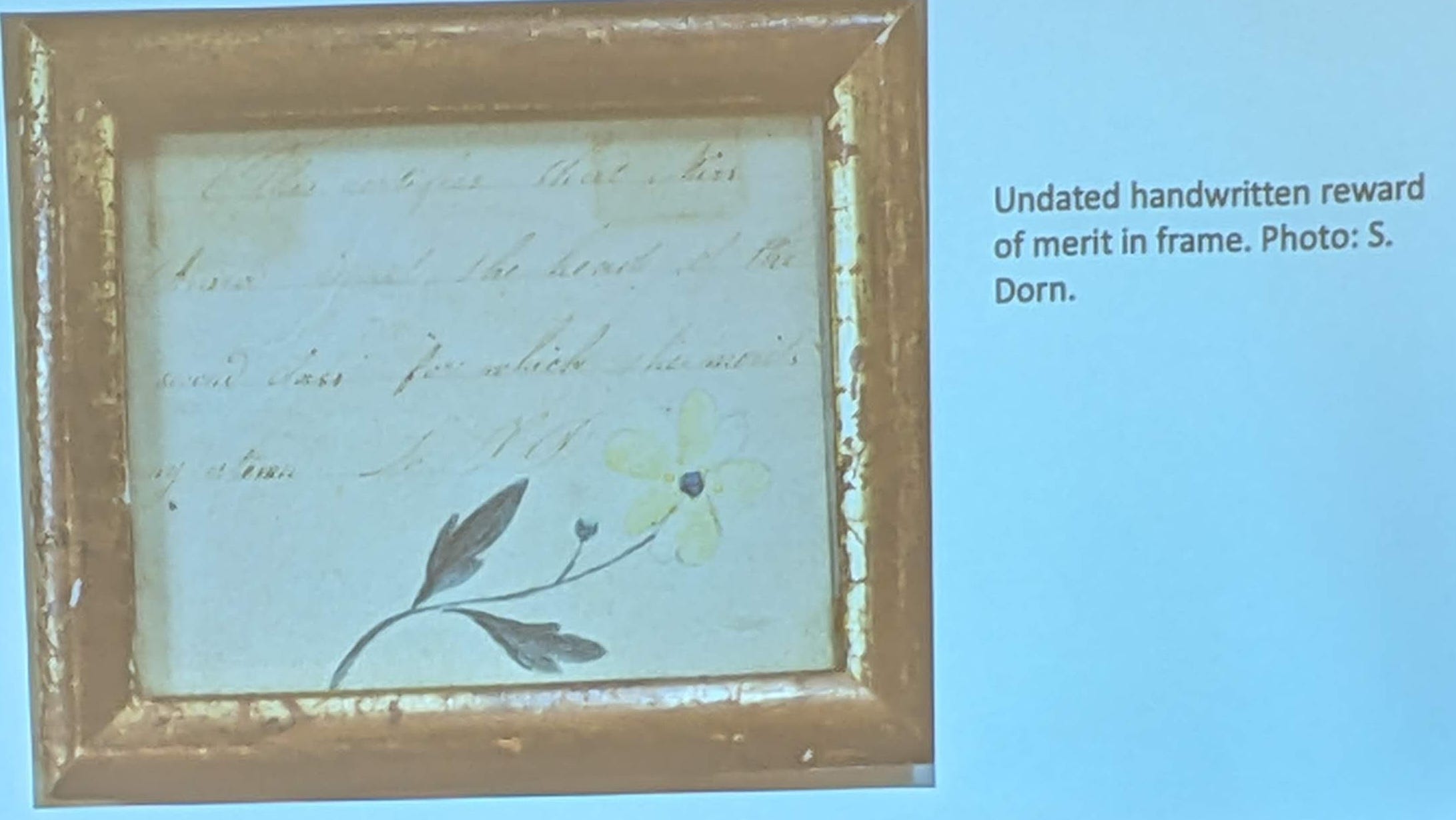
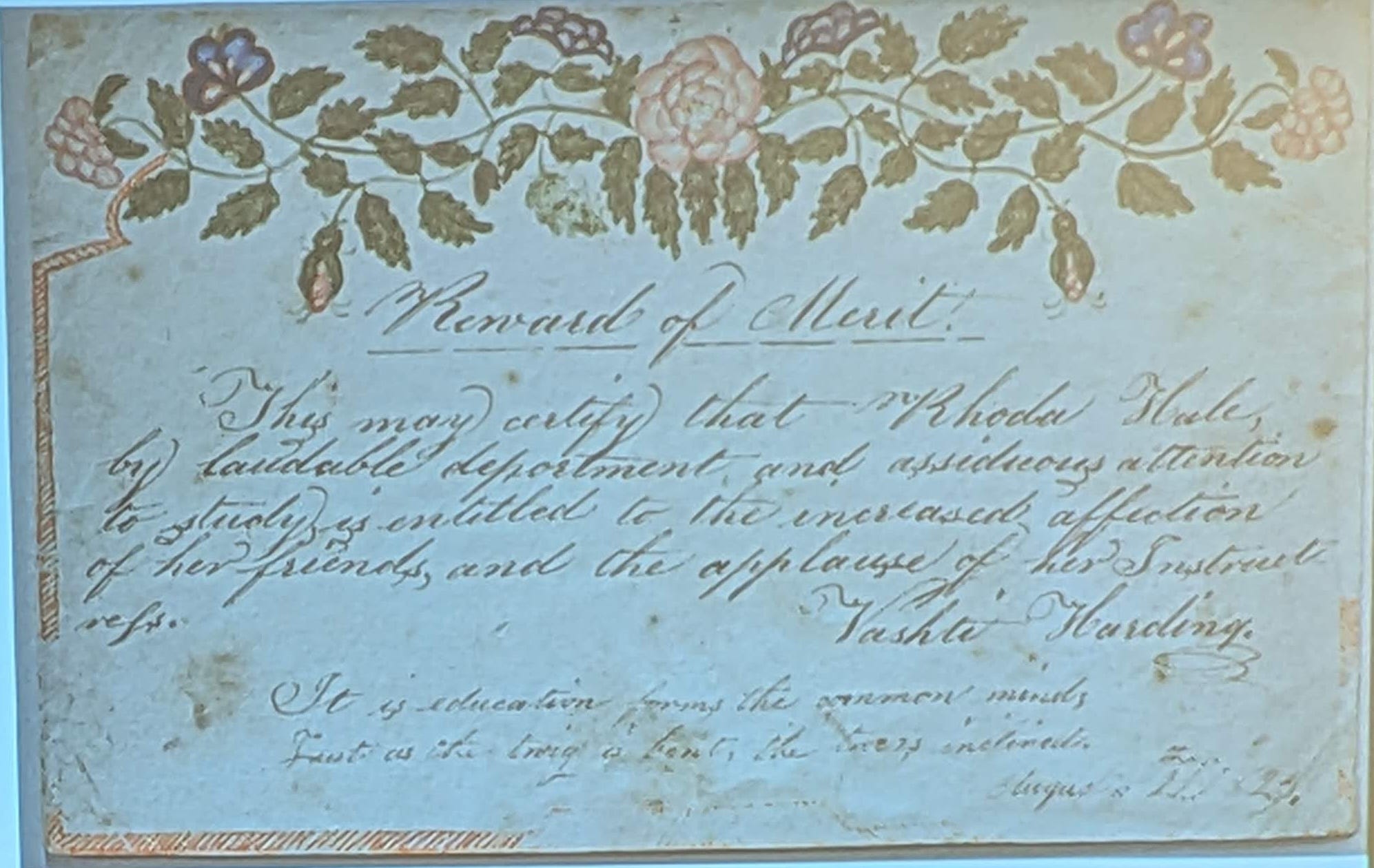
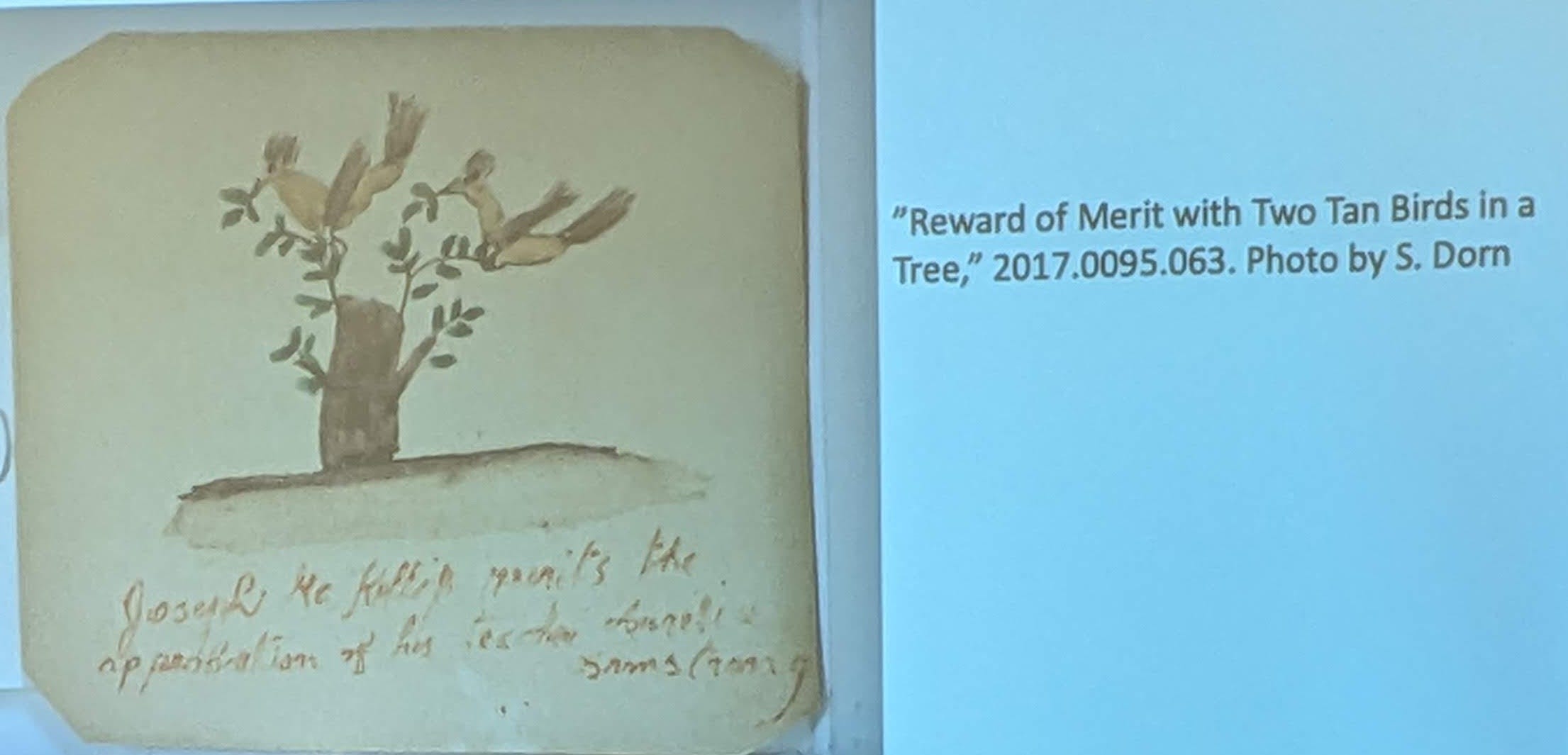
Photographs by Sherman Dorn, based on collections in the Lodish Collection of the Smithsonian’s Museum of American History.
I also gave a paper at the conference, on the role of emotion in historical interpretation, which has been a long-term interest of mine.
My paper discussed the “crisis theologians” of the early twentieth century—Karl Barth, Rudolf Bultmann, Emil Brunner, Dietrich Bonhoeffer, and others—who both influenced and were influenced by contemporary developments in existentialism. Drawing from Søren Kierkegaard, these authors argued that faith is inherently personal—that “no man may bring another to the peculiar, immediate, penetrating certainty” of God’s righteousness—and that existence confronts individuals with choices that cannot be rationalized or essentialized. Human beings participate in a preexisting and fallen world, burdened by the responsibility of their own imperfection. For instance, Karl Barth wrote that although we exist “inside” God’s love and creation, we struggle under a false consciousness, “a dark, enigmatical, inexplicable sense of being outside and of lacking a premise.” “The last things loom ahead of us distant, strange, problematical, immense,” he observed. “The unredeemed mind of man, split off from the mind of the Creator, denies its Origins, denies itself.” It was only through radical faith in Christ that one could reestablish communion with God, and meaning in the face of nihilism.
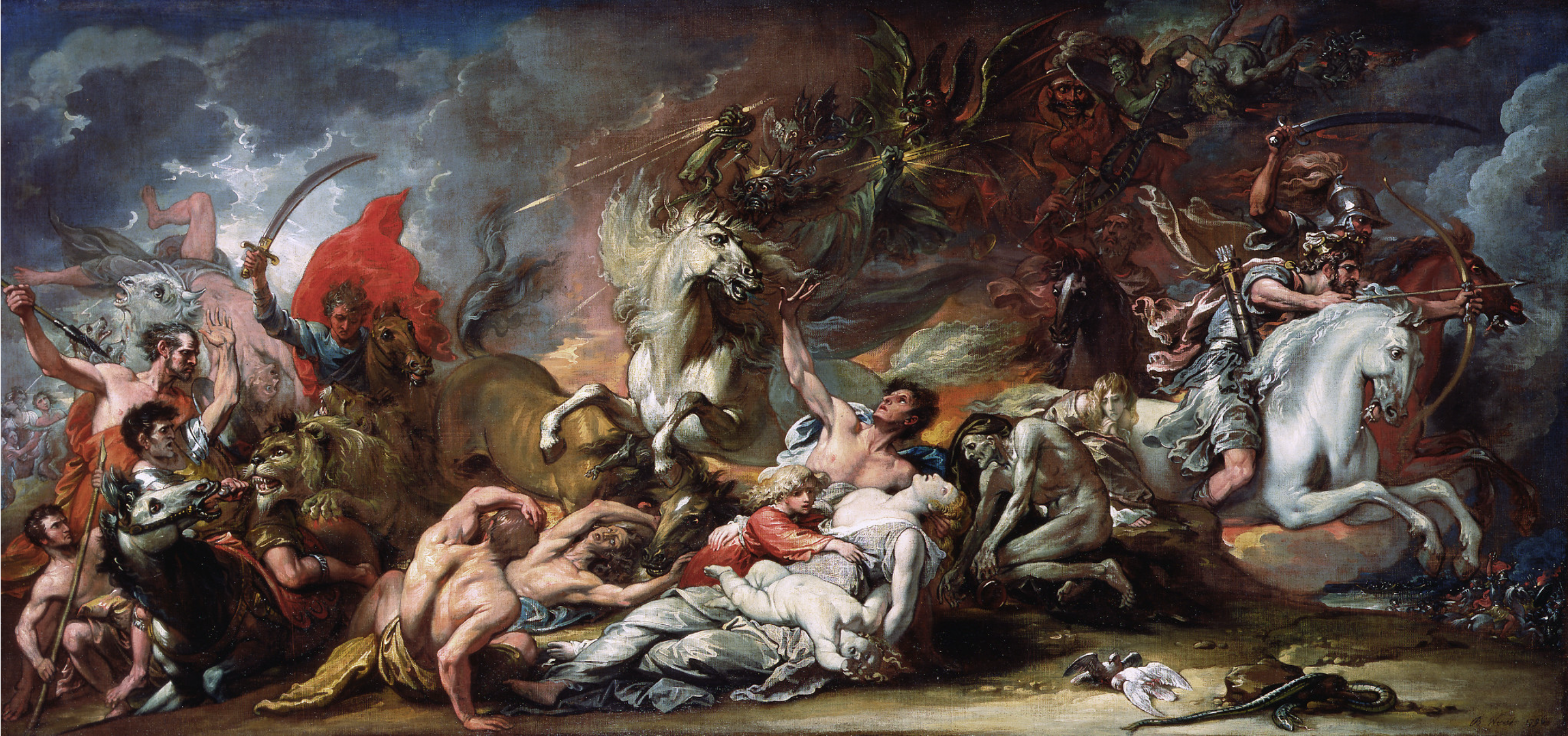
Benjamin West, “Death on a Pale Horse” (1796)
Meaning requires subjective feeling—indeed (back to Kierkegaard) it requires heightened feeling, which the crisis theologians interpreted as a type of ontological shock, deeper than secular rationality and outside of subject/object distinctions— something similar to Nietzsche’s notion of “the Dionysian.” As Barth put it, “the agitating thought of a radical otherness evading all human grasping, the terrible reminder of the ruptures in our self-sufficiency…is really the ‘ultimate fact’ of each of the sciences, evidence that ‘the so-called academic cosmos is an eddy of scattered leaves whirling over a bottomless pit.’” There’s the autumn wind again.
For Barth, faith “is not a meaning apart from other meanings, for in it all others—the meanings of natural science, of history, of esthetics, and of religion—are at once included and concluded.” In a state of faith the academic disciplines become contingent and subordinate to a vision of divine being. This perspective is particularly relevant to my own academic discipline of history.
Bultmann argued that because spiritual redemption is “part of the history in which we have our being, or in which by critical conflict we achieve being,” and because “we do not stand outside historical forces as neutral observers,” we must achieve “a highly personal encounter with history,” engaging the past fulsomely and dialogically. Historical knowledge is not a matter of “theoretical reflection,” he insisted, but an attitude that “appears anew at every moment, because in each moment God claims man,” although “that means that man in his present life stands continually at the crisis of decision.” Thus, attempts at scientific objectivity in historical analysis are profoundly misguided. Brunner observed that “even the most outstanding scientific discoveries, such as those of Copernicus or Darwin, barely penetrate the surface of man’s being….Taken by themselves they have not the ‘temperature’ of truth. In other words, scientific truths are relative; they join units to units, things to things. They never touch the heart of things.” The idea here is that any authentic form of knowledge requires not only objective logic but subjective meaning, which derives from deeper structures of existence and that transcend traditional notions of time.
As I have written elsewhere, this existential perspective on the past aligns closely with Paul Tillich’s concept of “theonomy”: that substrate of reality which underlies both reason and emotion, and which we grasp (or which grasps us) only in moments of revelation. We can only encounter the world through pre- or supra-rational “moods.” Just as small acts of care imbued certificates of merit with much deeper meanings, for Tillich, “knowledge of revelation can be received only in the situation of revelation, and it can be communicated…only to those who participate in the situation. For those outside this situation the same words have a different sound.”
If the Germans and Swiss have most thoroughly outlined the theological aspects of existential awareness, in history its extrapolation has fallen largely to the Dutch. In 1837, Nicolaas Beets wrote that the Enlightenment “gave us the chilly formalism of A + B = C. The temperature decreased from that of human blood to that of frost. It literally snowed big ideas. It was fresh but, in the end, uncomfortable cold.” An alternative would appear at the turn of the twentieth century, when Johan Huizinga wrote about the “autumntide” of the Middle Ages. (The English translation of Huizinga’s book is called The Waning of the Middle Ages: obviously a poor substitution.) Huizinga argued that, when trying to understand a bygone era, archival evidence could take us only so far. Instead, he recommended approaching history with an emotional immediacy, as in “a moment’s drunkenness.” The historian needs to “walk across meadows and hills, until he can also see the sun shining in the past.”
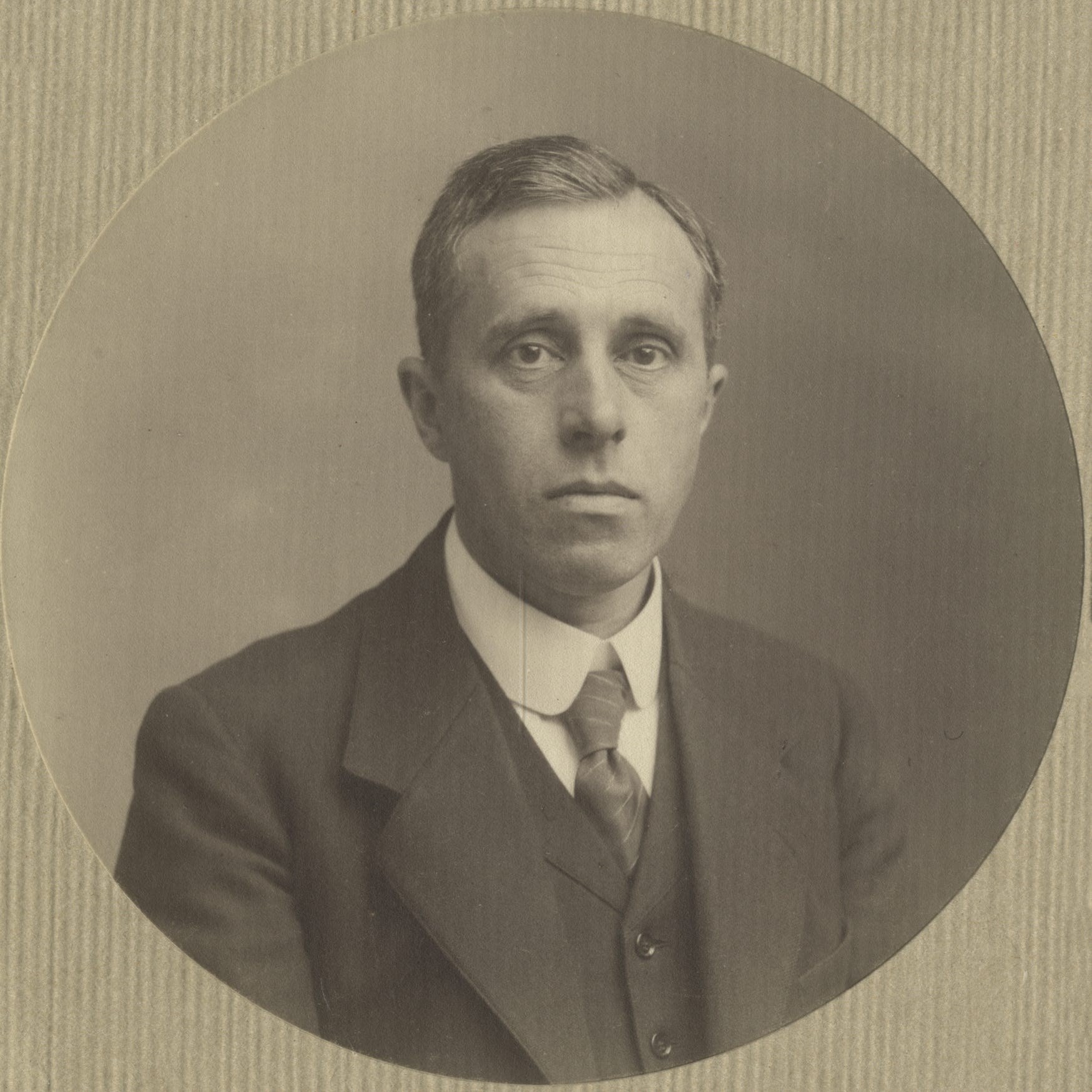
Johan Huizinga
Indeed, as Willem Otterspeer points out, Huizinga was willing to tolerate some anachronism in the search for historical truth. To understand the interplay of chastity and sensuality in chivalric literature, for instance, required types of emotional perception unavailable in dusty old manuscripts, but sumptuously captured in the (much later) paintings of Edward Burne-Jones.
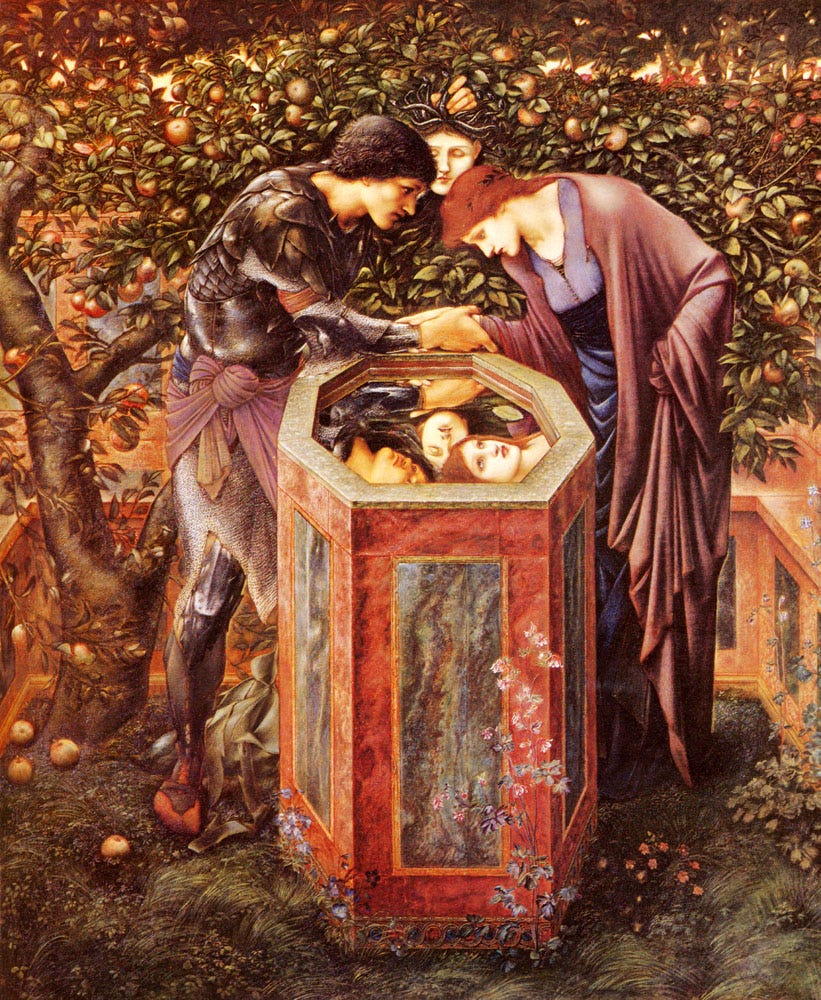
Edward Burne-Jones, “The Baleful Head” (c. 1887)
All of this stands in stark opposition to how we currently teach and write history, which most historians still conceive as a chronological litany of facts, dates, and themes, or perhaps as a toolbox of analytical skills. The regime of “historical thinking” needs to make room for what the Dutch historian Frank Ankersmit calls “historical experience”: a type of emotional sympathy, much like Tillich’s theonomy, that fuses objective and subjective experience of the past into a vital whole. Knowing the past requires an awareness of our own emotional lives, Ankersmit writes. Strangely, however, “I succeeded in recognizing it in myself only after having observed this kaleidoscopic interacton of moods in the past--where, paradoxically, the reverse seems to be no less true as well. Here past (object) and present (subject) merge in pure experience, an experience without a subject of experience.” “In moods,” he concludes, “there is no ‘I,’ there are no objects, and no borderlines between the self and the objects of the world. One should rather say: the borderlines of the self fade away and disappear in a peculiar way. Self and world are embedded in an undivided totality of experience.”
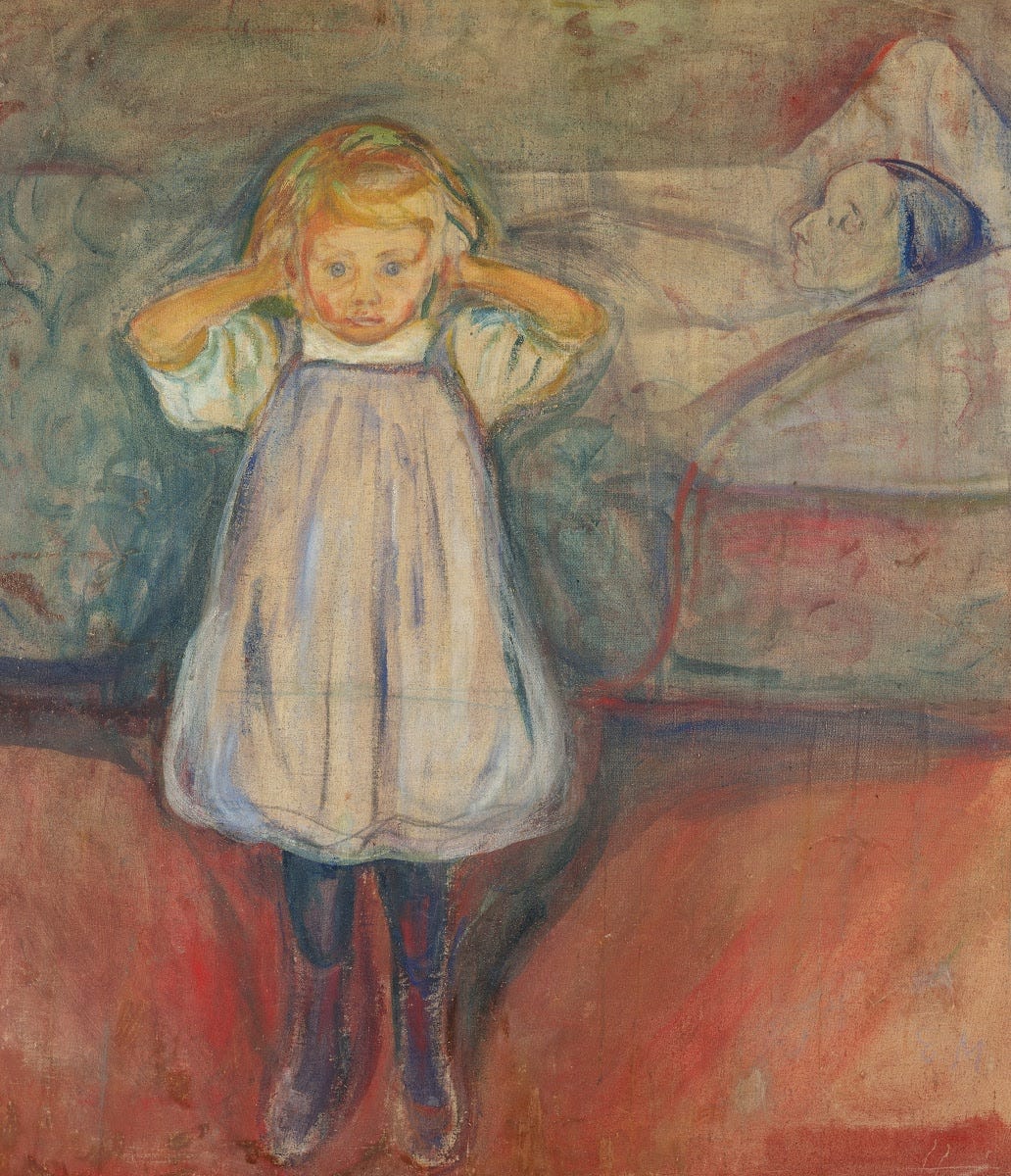
Edvard Munch, “Death and the Child” (1899)
As Zohar Atkins writes:
Somewhere along the way, we forgot that understanding origins is not the same as understanding meaning. We learned to master texts without letting them master us. Never mind that there’s arrogance baked into assuming you can truly reconstruct the forces that caused a text to come into being; there’s a deeper problem: the reduction of a text’s meaning or wisdom to its compositional history or ideological context….Here’s what we’ve lost: you cannot love what you’ve already reduced. The sequence matters. Not context then love. Love then context.
Instead of promoting standards-based or even disciplinary approaches to the past, perhaps we could encourage students to experience history as surfers experience the ocean: by fostering “engagement with wind, water and waves as a dynamic and reciprocal form of cosmic play that continuously emerges anew.” The idea here is not to stoke sentimentalism or irrational exuberance, and not to enslave ourselves to shallow forms of relevance or student interest, but to infuse the past with a vital element of emotional warmth. In the classroom, we might ask, with Kierkegaard, “Why bother remembering a past that cannot be made into a present?” And in our writing, we might affirm, with Franz Kafka, that a book must ultimately be an “axe for the frozen sea within us.”
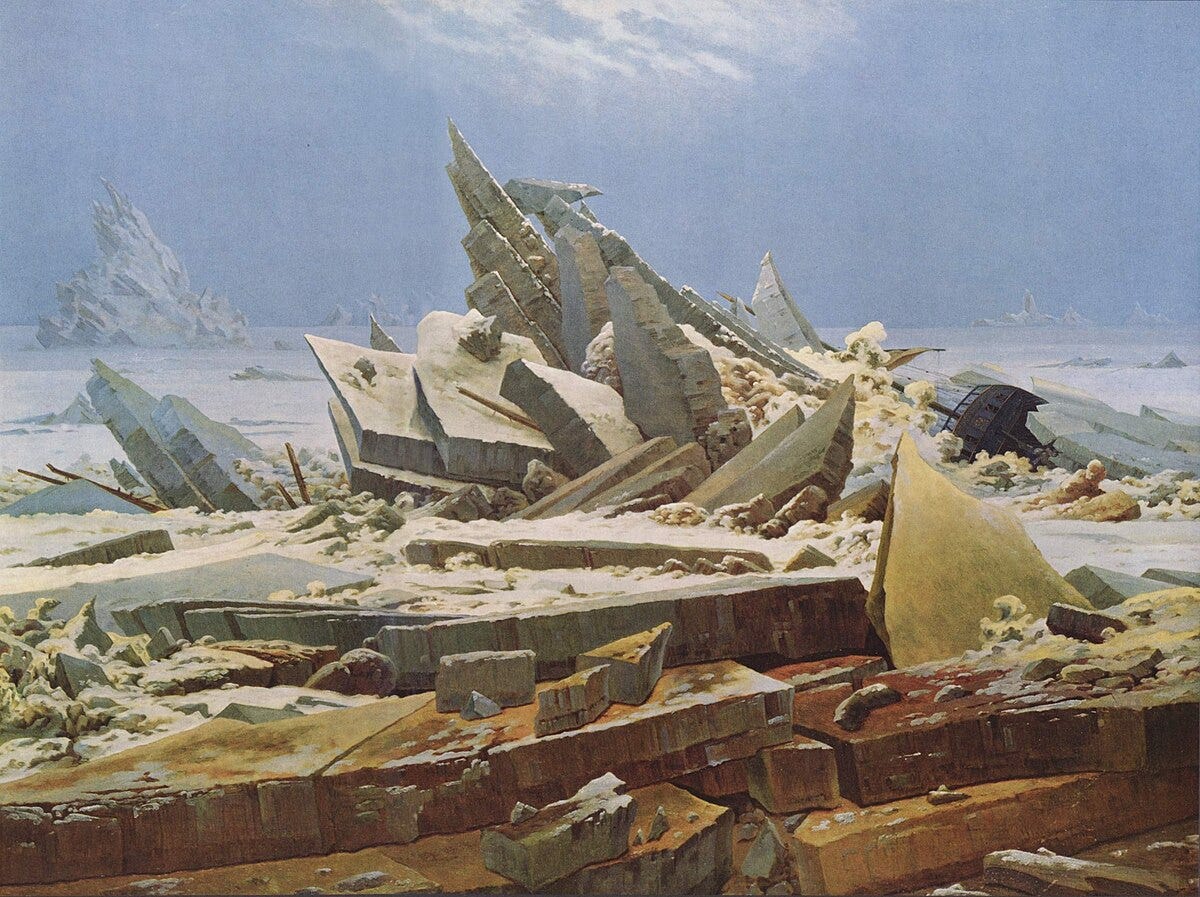
Caspar David Friedrich, “The Sea of Ice” (1824)