
Kids Knowing Stuff


Massimo Rumi, “Mongolian Child With a Golden Eagle” (2016)
There is a scene, early in Madeline Miller’s novel Circe (2018), where the title character and her brother Aeëtes, demigods and children of the Sun, are talking:
I would lean my cheek upon his shoulder and he would ask me questions that I had never thought of and could barely understand, like: How does your divinity feel?
‘What do you mean?’ I said.
‘Here,’ he said, ‘let me tell you how mine feels. Like a column of water that pours ceaselessly over itself, and is clear down to its rocks. Now, you.’
The experience of divinity requires a type of introspection that is new to Circe. She offers some halfhearted answers. “Like breezes on a crag”? “Like a gull, screaming from its nest”? Knowledge of one’s own being is hard to put into words, appearing as it does on the boundaries of epiphany and assurance, intuition and proof, the universal and the particular.
Of course, most day-to-day experience is hard to put into words. My students always get caught short when we read Plato’s Meno and they discover that repeating certain words in response to other words is not the same as knowing something. By the standards of logical proof, most of us know almost nothing. Aristotle elaborates on earlier and more accessible types of knowledge, including phronēsis (a knack for prudence and good choices) and technē (the ability to accomplish a task, as a craftsman or practitioner), but even these have a deep mystery lurking beneath them. As David Aldridge points out, knowledge is not something that one can “insert” into a child’s brain; indeed, this is why Plato argues for the eternity of the soul and the “recollection” of eternal forms, which sidesteps the leap from not-knowing to knowing and the troubling question of ontological change. Coming-into-knowledge is also coming-into-being; there is a transformative aspect that is outside of one’s own control and yet deeply implicated in one’s sense of self. Do you remember when you first tied your own shoes or learned to whistle? When you hit your first home run or made your own dinner? There is sort of a magic to knowing things, and knowing that you know them. Knowledge produces an overflowing well of selfhood much like Aeëtes’ pillar of water.
In The Aesthetic Education of Man (1795), Friedrich Schiller argues that this sort of transcendence becomes clearest in moments of aesthetic experience—the contemplation of beauty and the sensuous perception of truth—and indeed, that it is an aesthetic experience in itself, a “wonderful emotion for which reason has no conception and language no name.” He associates that emotion with children’s play. The individual at play engages the world actively, fully, and freely, achieving an almost divine state of potentiality, leading Schiller to the famous pronouncement that “man only plays when he is in the fullest sense of the word a human being, and he is only fully a human being when he plays.”
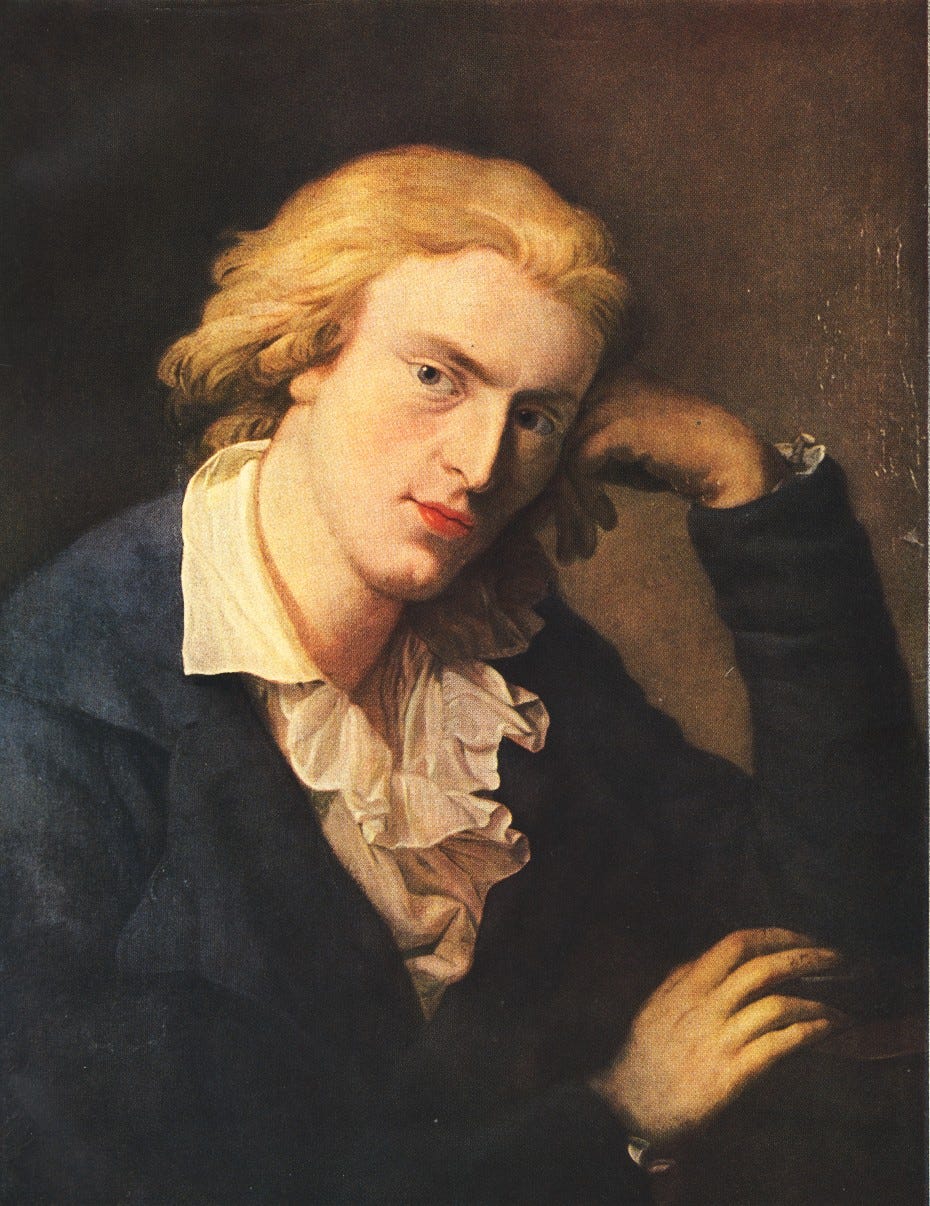
Friedrich Schiller
Friedrich Nietzsche would take up similar images throughout his career. In The Birth of Tragedy (1872), Nietzsche introduces the categories of the Apollonian (the rational aspects of knowledge, art, and selfhood) and the Dionysian (the irrational types of knowledge that we associate with sublimity, mysticism, and self-loss). Both are vital components of a meaningful life, yet schools teach them only rarely and accidentally. That may not be surprising in the case of the Dionysian—which by definition is a little dangerous and unpredictable—but it is important to note the lack of truly Apollonian experiences as well, those moments when a child can feel knowledge as theirs and not as something exogenous, performative, or narrowly utilitarian.
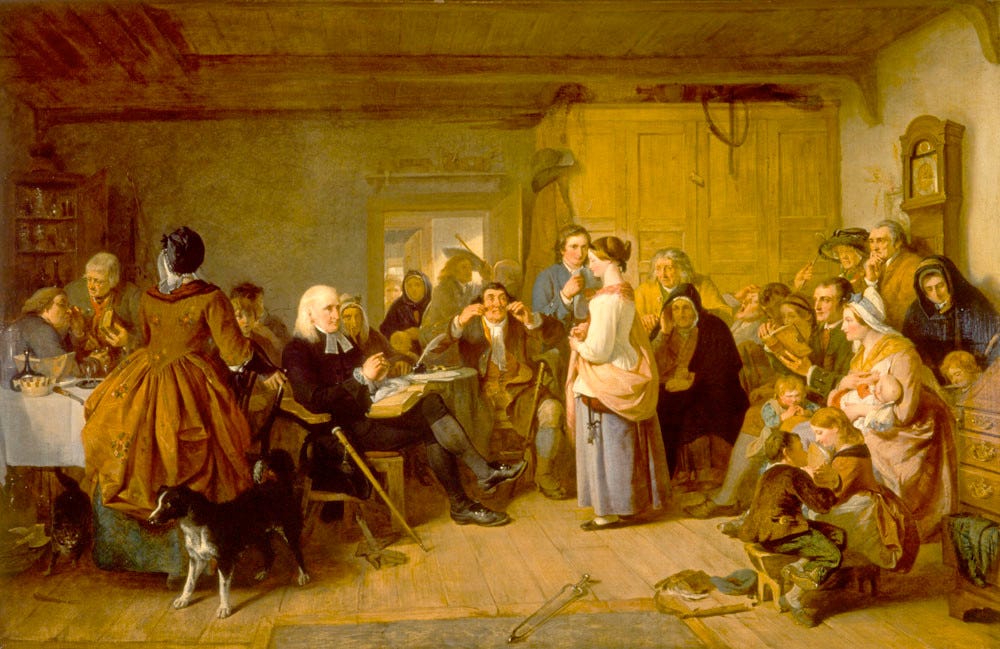
John Phillip, "Presbyterian Catechising" (1847)
The latter shortcomings are perhaps clearest in the lives of child prodigies—whether mathematical, musical, athletic, or otherwise—whose abundant and untaught knowledge seems to elicit only two responses from adults: (1) amazement at the “gift” and incessant demands for demonstration, which reduces the child to a one-dimensional parlor trick; or (2) idolatrous visions of “potential,” as if the child were an untapped resource who “owes something” to society. From Schiller or Nietzsche’s perspective, these impulses spring from mediocrity and conformity trying to harness what they cannot understand. Both deaden the child’s sensitivity and alienate them from the experience of joyful knowledge.
These dynamics are front and center in Bill Reese’s forthcoming book about Zerah Colburn, a human calculator from early-nineteenth-century Vermont. As his amazing abilities came to light, Colburn’s father took him around the United States and to all the courts of Europe, seeking an adequate “situation” and means of support for the boy. When his father died, leaving him stranded in France, and the shine (though not the substance) had faded from his mathematical abilities, Colburn, for the first time in his life, had to decide what he actually wanted to be. He chose itinerant preaching and eventually became a professor at a local academy, before dying young at the age of thirty-five. Reese discusses the developments in media, celebrity, and statecraft that surrounded Colburn and shaped his unusual childhood, but (despite valiant efforts in the archives) the boy often remains an enigma at the center of his own story.
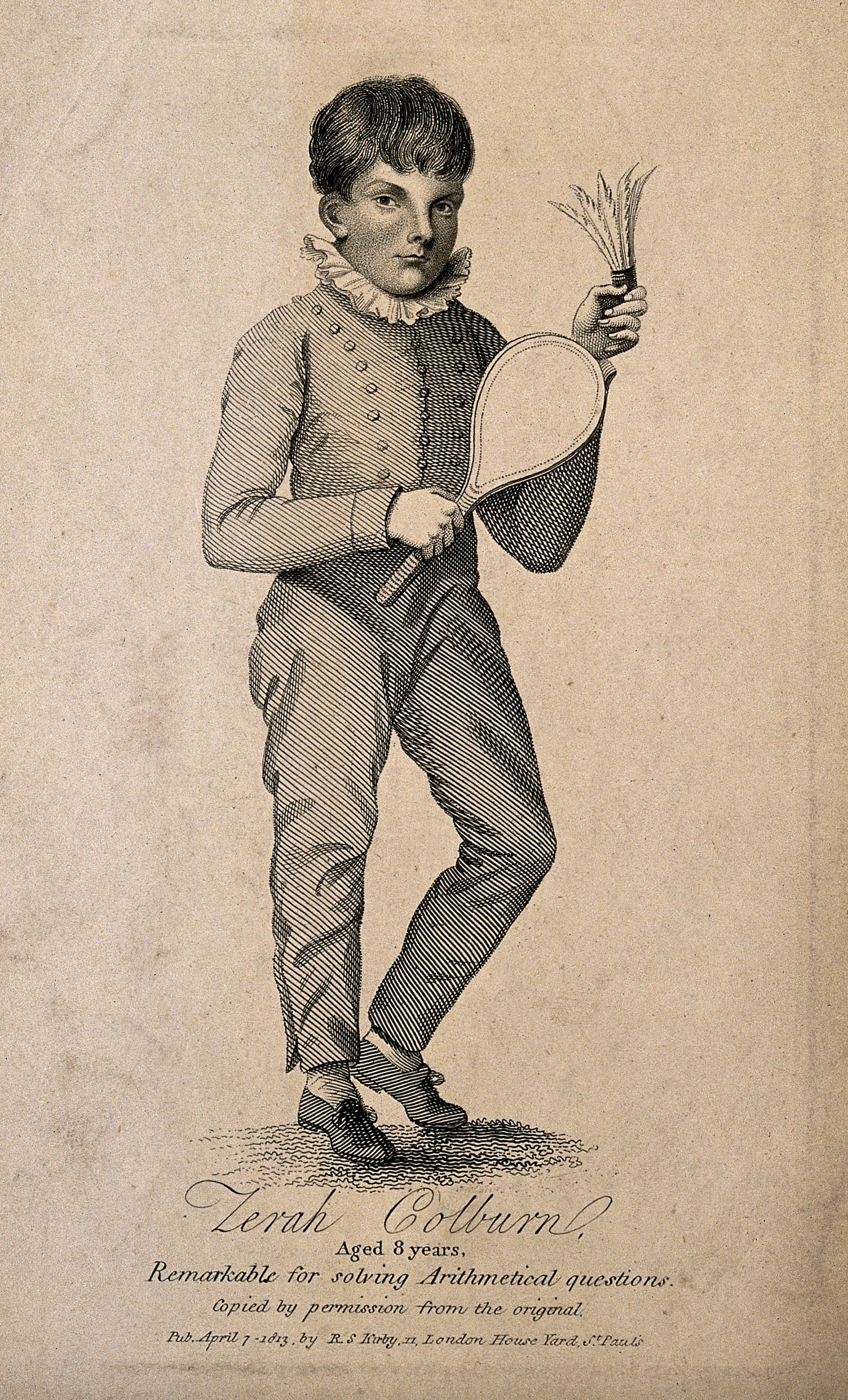
Zerah Colburn
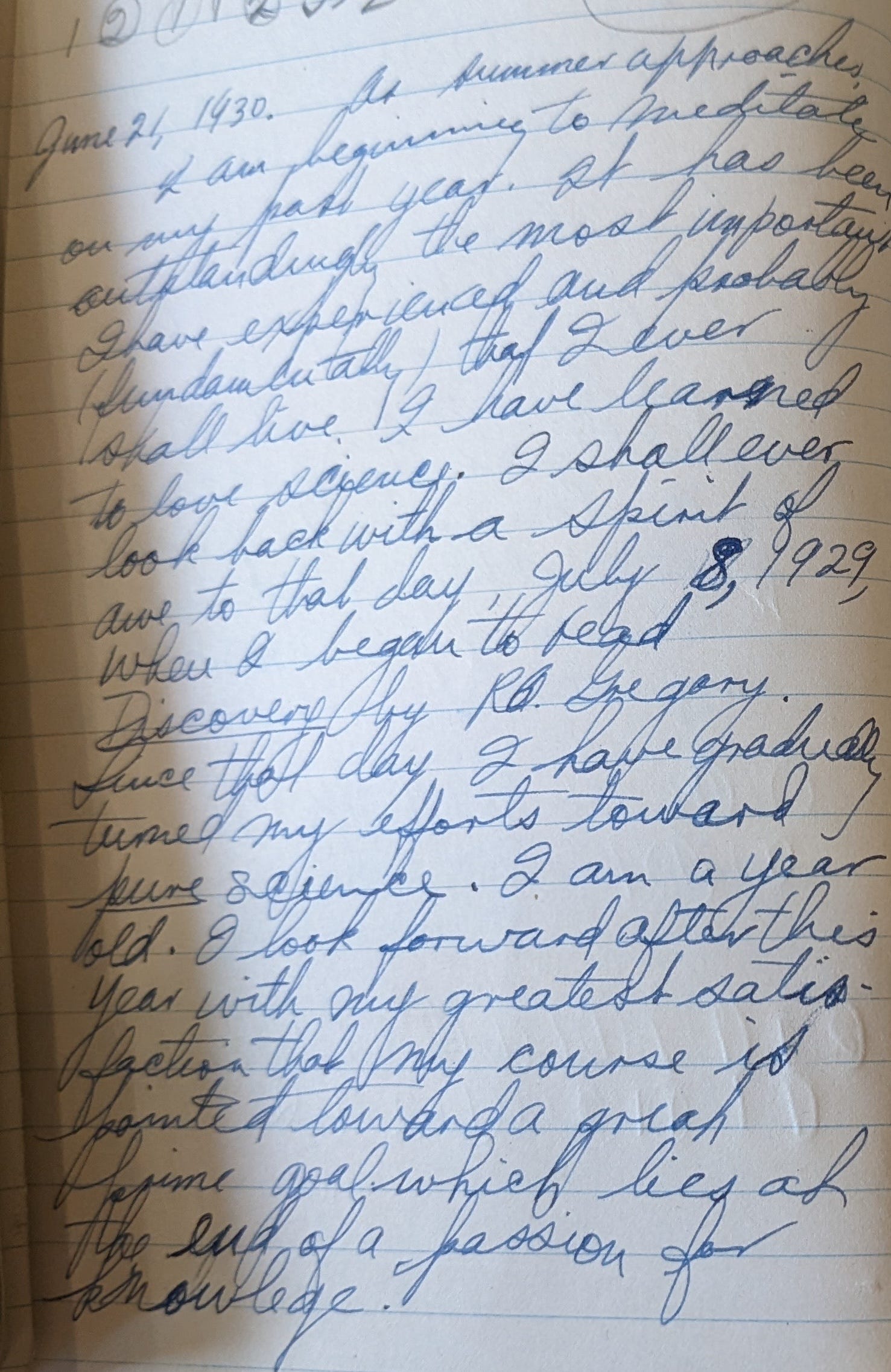
I have a forthcoming piece about the philosopher Philip H. Phenix that hits different notes, largely because of a childhood diary that the Phenix family shared with me. In its pages, one sees Phenix in a state of nascent and reflective self-creation. As an eleven-year-old, he got interested in electrical engineering, building simple circuits and crystal radios. And then something inexplicable happened. Over the next three years, his mind caught fire. He taught himself chemistry, biology, physics, and astronomy, while developing a deep religious commitment to the regularity and perceptibility of God in nature. In doing so, he was outlining (sometimes verbatim) what would become his adult philosophy, dedicated to reverence and the divine sources of learning. I don’t really know what to do with all this, and neither did he. In his last diary entry, looking back at a period that amazed him as much as anyone else, Phenix wrote:
I am beginning to meditate on my past year. It has been outstandingly the most important I have experienced and probably (fundamentally) that I ever shall live. I have learned to love science. I shall ever look back with a spirit of awe to that day, July 8, 1929, when I began to read Discovery by R. Gregory. Since that day I have gradually turned my efforts toward pure science. I am a year old. I look forward after this year with my greatest satisfaction that course is pointed toward a great prime goal which lies at the end of a passion for knowledge.
I suppose the point is that knowledge is only real when it is personal, not when it produces the right words or formulas, not even when it calls forth committed belief, but when it deepens one’s experience of the soul, allowing individuals to live in harmony with the world around them, and in peace and confidence with themselves, no matter their age.
“Sugar Chile” Robinson