
Prophecy and Protestant Poetics


Farmington (NY) Monthly Meeting of Friends
Two things struck me while reading to my kids over the past year. First, going through Anne of Green Gables with my daughter, was the book’s comic but climactic reenactment of “The Lady of Shalott.” It’s hardly surprising that Anne, the starry-eyed daydreamer, is enchanted by Tennyson. (The best part of my commute is whenever Marianne Faithful comes on the playlist.) Although she is surrounded by more levelheaded peers and adults, Anne comes of age during the heyday of poetry recitations in schools and public gatherings, a time when lyricism could command emotion and reverence. It is hard to overstate how far we have fallen since then. Today’s schools devote little time to reading (much less memorizing) poetry, and the lingering fug of the new criticism leaves no room for transcendence or appreciation of la ligne donée.
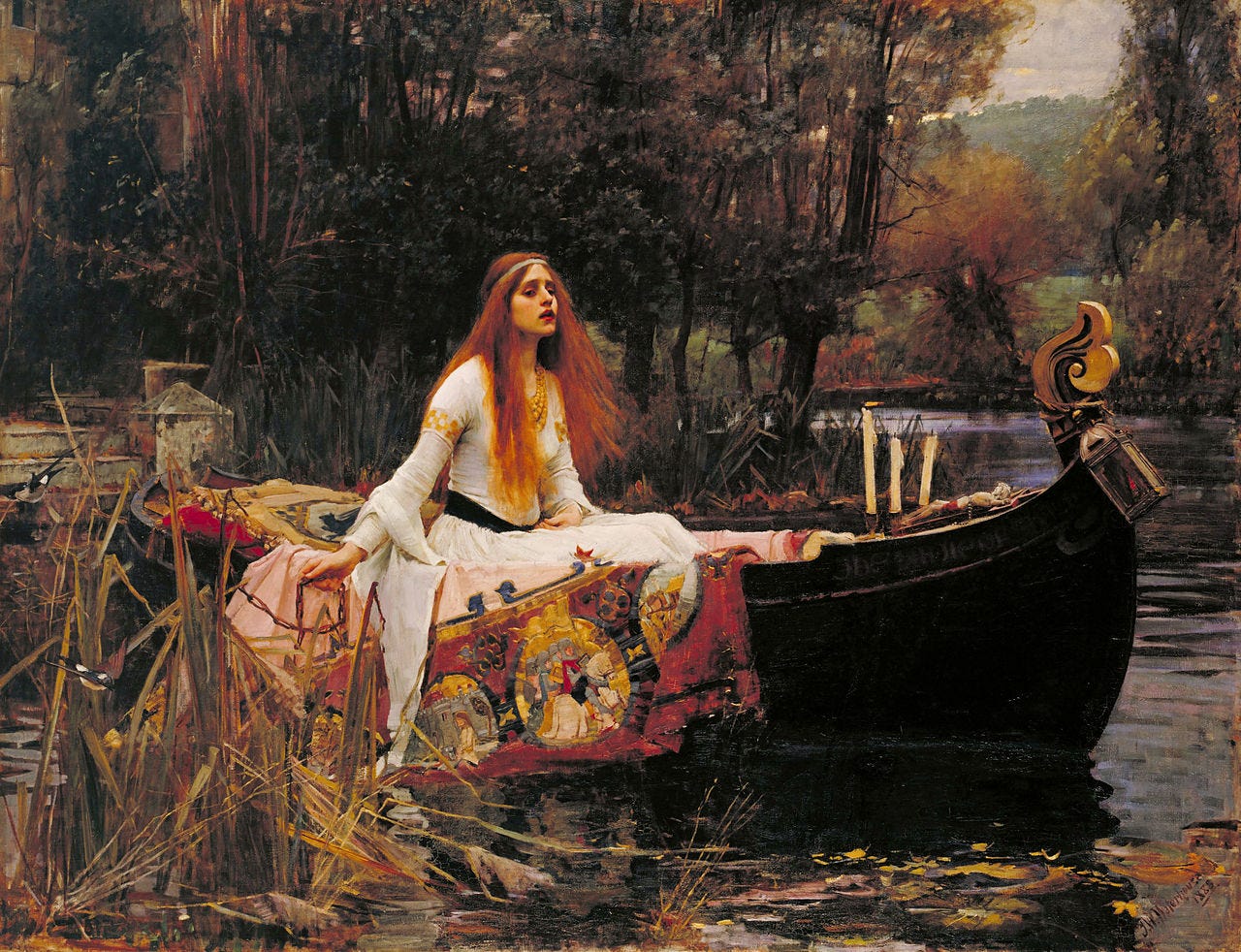
John William Waterhouse, “The Lady of Shalott” (1888)
Second, reading Moby Dick with my son (who thinks we should have just skipped to the last chapter), was Melville’s juxtaposition of Old Testament prophecy and American modernity. Some of my favorite passages appeared in an earlier post, but suffice to say that the book’s meditations on evil, fate, and sublimity draw on a type of religion that I can understand:
“Shipmates, this book, containing only four chapters—four yarns—is one of the smallest strands in the mighty cable of the Scriptures. Yet what depths of the soul does Jonah’s deep sealine sound! what a pregnant lesson to us is this prophet! What a noble thing is that canticle in the fish’s belly! How billow-like and boisterously grand! We feel the floods surging over us; we sound with him to the kelpy bottom of the waters; sea-weed and all the slime of the sea is about us! But what is this lesson that the book of Jonah teaches? Shipmates, it is a two-stranded lesson; a lesson to us all as sinful men, and a lesson to me as a pilot of the living God. As sinful men, it is a lesson to us all, because it is a story of the sin, hard-heartedness, suddenly awakened fears, the swift punishment, repentance, prayers, and finally the deliverance and joy of Jonah”…
Excepting the sublime breach—somewhere else to be described—this peaking of the whale’s flukes is perhaps the grandest sight to be seen in all animated nature. Out of the bottomless profundities the gigantic tail seems spasmodically snatching at the highest heaven. So in dreams, have I seen majestic Satan thrusting forth his tormented colossal claw from the flame Baltic of Hell. But in gazing at such scenes, it is all in all what mood you are in; if in the Dantean, the devils will occur to you; if in that of Isaiah, the archangels….
Swerve me? The path to my fixed purpose is laid with iron rails, whereon my soul is grooved to run. Over unsounded gorges, through the rifled hearts of mountains, under torrents’ beds, unerringly I rush! Naught’s an obstacle, naught’s an angle to the iron way!…
All men live enveloped in whale-lines. All are born with halters round their necks; but it is only when caught in the swift, sudden turn of death, that mortals realize the silent, subtle, ever-present perils of life.
I had an amazing English teacher in high school and was surrounded by incredibly smart classmates, but I still remember how strange it felt to dissect passages like these from a secular perspective (n.b., we read Billy Budd rather than Moby Dick), while the subtlety (to say nothing of the feeling) of biblical allusions went unnoticed and unremarked. Public schools have never taken religious conviction all that seriously, but it is hard to see how one can grasp aesthetic meaning without it. At the risk of sounding cranky and nostalgic, it feels like there was once a time when poems mattered and prophecy retained its potency.
This has been on my mind because, amid a resurgent Catholicism (much of it of the “RETVRN” variety…) and cringey pleas for liberal humanism, it seems that we might benefit from the culture of old-school Protestantism. And I don’t mean the type of MAGA/mega-church Protestantism that has prostrated itself to political idols since the 1960s. [Edit: To be clear: (a) I know that the Catholic revival draws from many sources, I am in favor of most of them, and I welcome robust religious pluralism in the public sphere; and (b) I will never be in favor of Cass Sunstein lecturing us about Bob Dylan.)
The style that I am thinking about is partly outlined in Noreen Khawaja’s The Religion of Existence (2016). Ostensibly a history of twentieth-century existentialism—both in its theistic (Jaspers, Buber, Levinas, et al.) and athetistic varieties (Heidegger, Sartre, Camus, et al.)—Khawaja does not begin where one would expect, with Kierkegaard or Pascal. Instead, she opens with German Pietism. It was the Pietists’ commitment to austerity, earnestness, and the amplification of feeling, Khawaja writes, that allowed modern Christians to find holiness in everyday experience and to affirm a life of faith. Again, this is a type of religion that I can understand, both because my current book project focuses on the interplay between Heidegger and neo-orthodox theologians and because I grew up in a Pietist community myself.
As I have written before, Protestant visions and jeremiads still animate some outsider artists, particularly in Black religious traditions. Take Sister Gertrude Morgan, for instance, who was a street-corner preacher, artist, and singer in New Orleans. Her art is better preserved than her music—as one commentator drily notes, there was never a big market for a capella solos backed by tambourine—but her songs echo both the ring-shout tradition and the type of immanent critique that one finds in Black theology. In the following recording, she implores the Holy Spirit to “Trouble the people! Don’t let them rest! Let them know they got a soul to save! Shake them up and wake them up!” It’s a message that is always worth hearing: the emphasis on individual judgement and its relationship to Eternal Judgement.
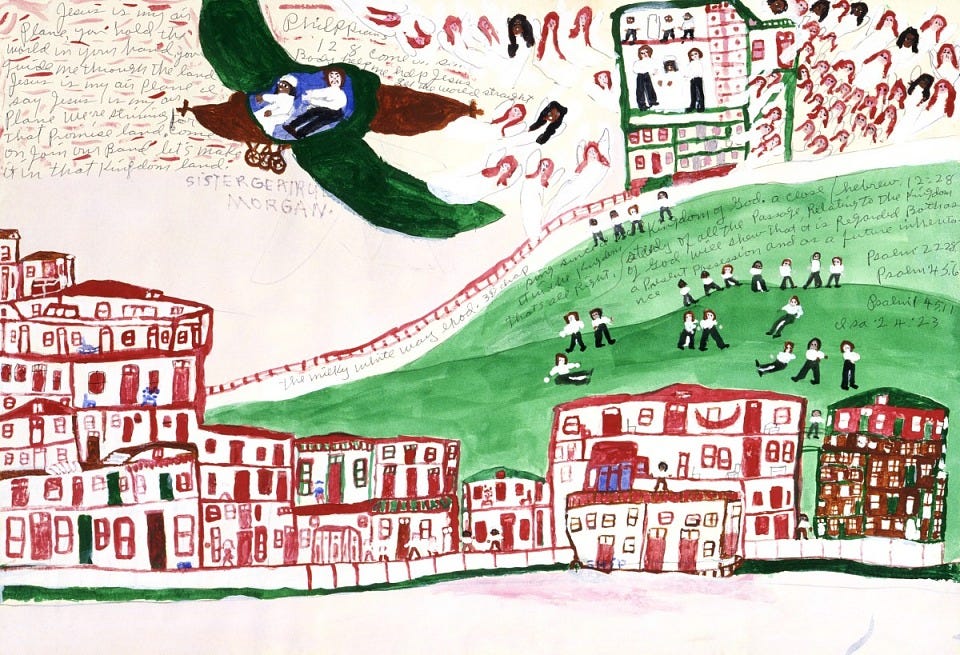
Sister Gertrude Morgan, “Jesus is my air Plane” (1970)
But Morgan’s invocation is merely a remnant of what, between the seventeenth and nineteenth centuries, was a pervasive cultural field. I had the opportunity to see echoes of that culture last week while (literally) running through the Milwaukee Museum of Art:
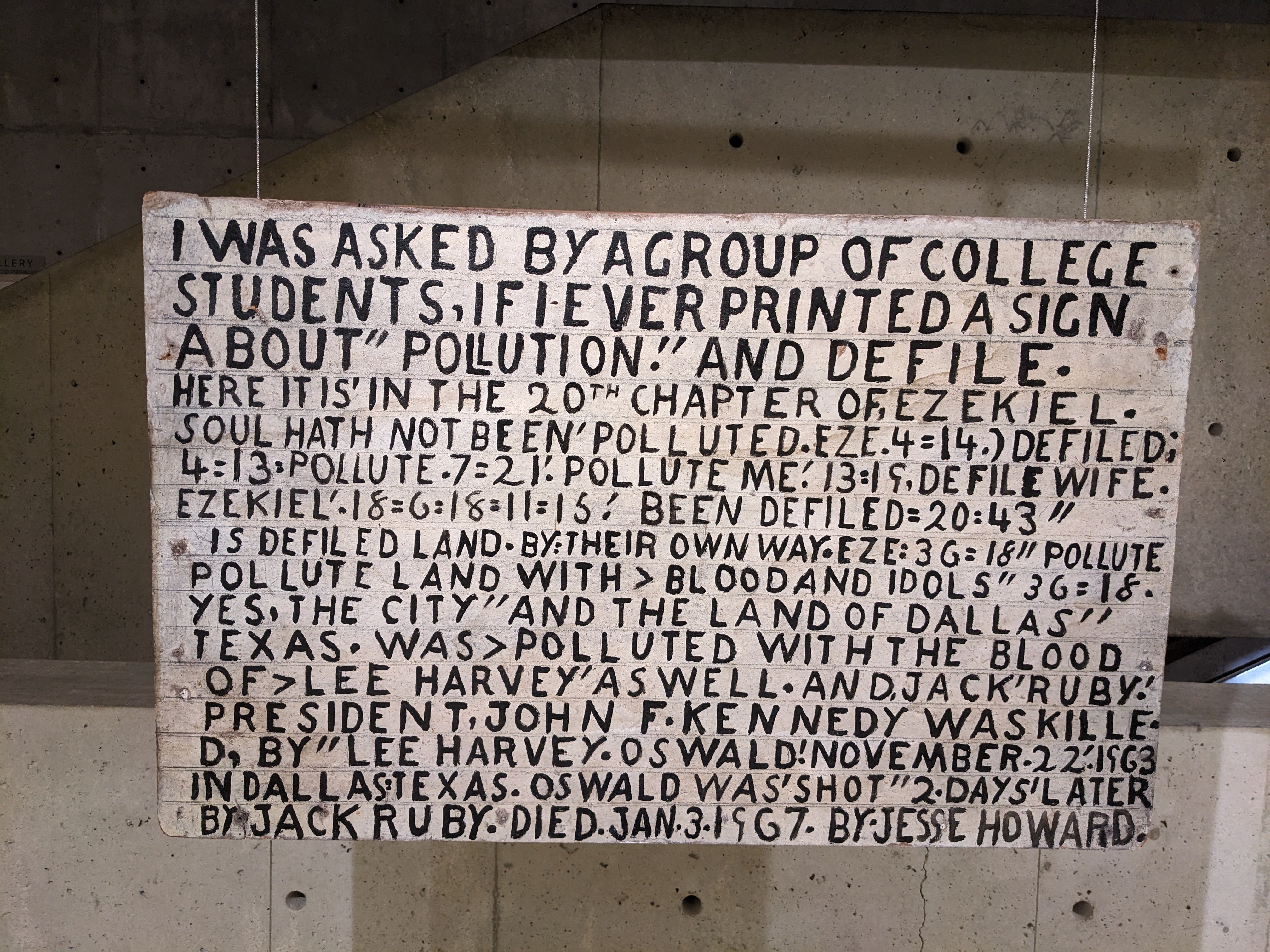
Jesse Howard, “Untitled” (n.d.) (See more of Howard’s work here.)
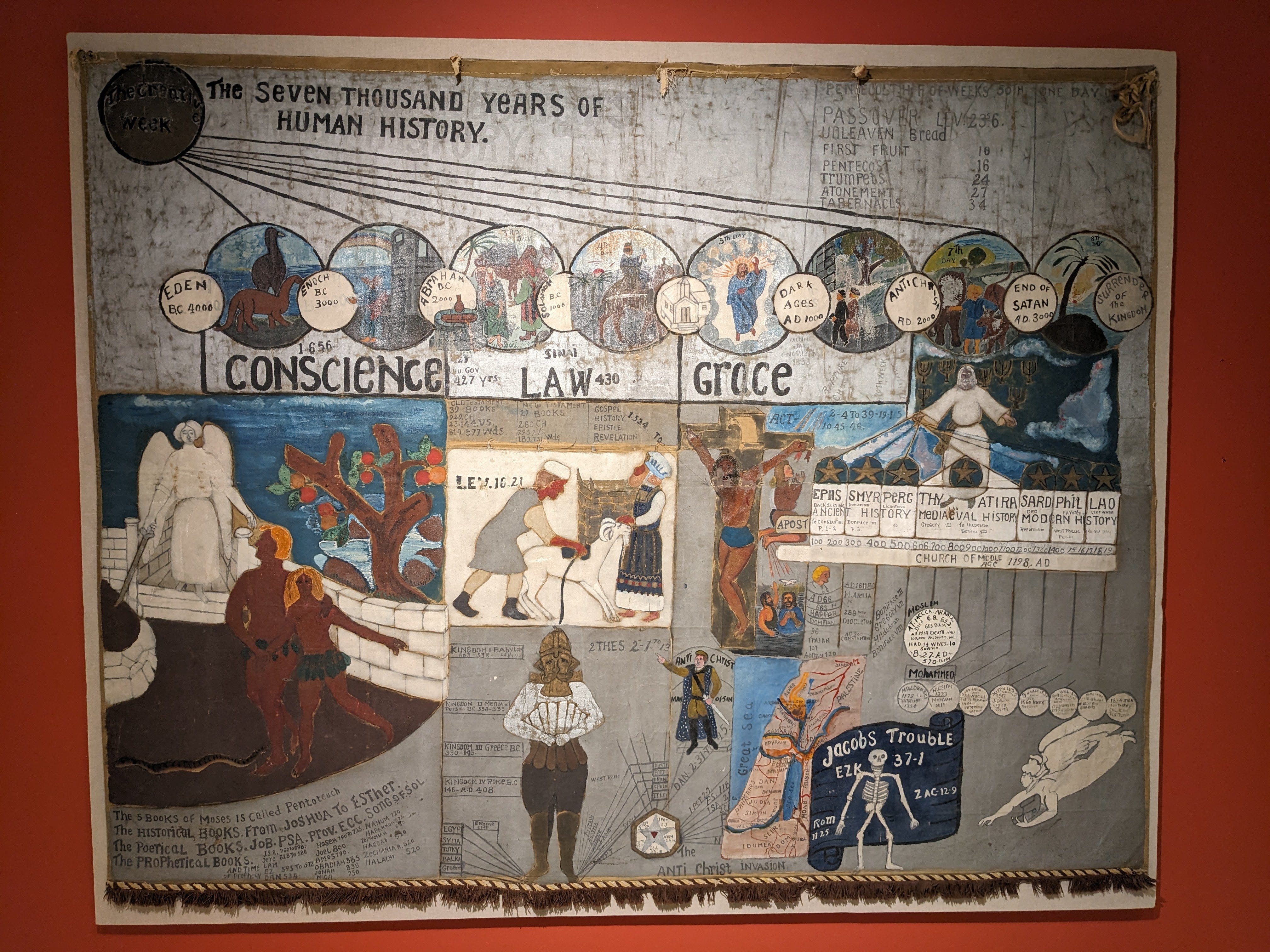
Josephus Farmer, “The 7000 Years of Human History” (n.d.) (See more of Farmer’s work here.)
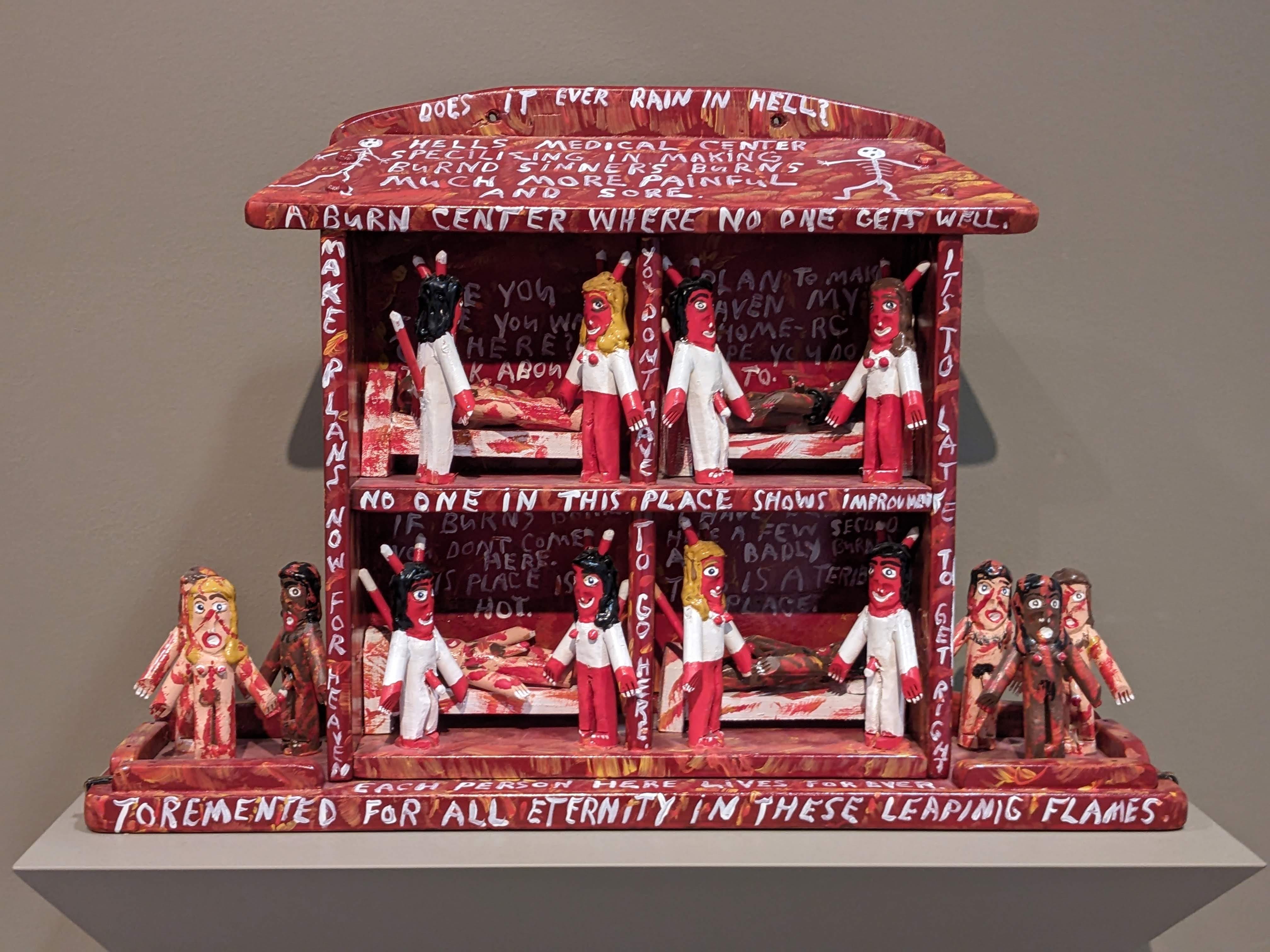
Ronald Cooper, “Hospital in Hell” (n.d.) (See more of Cooper’s work here.)
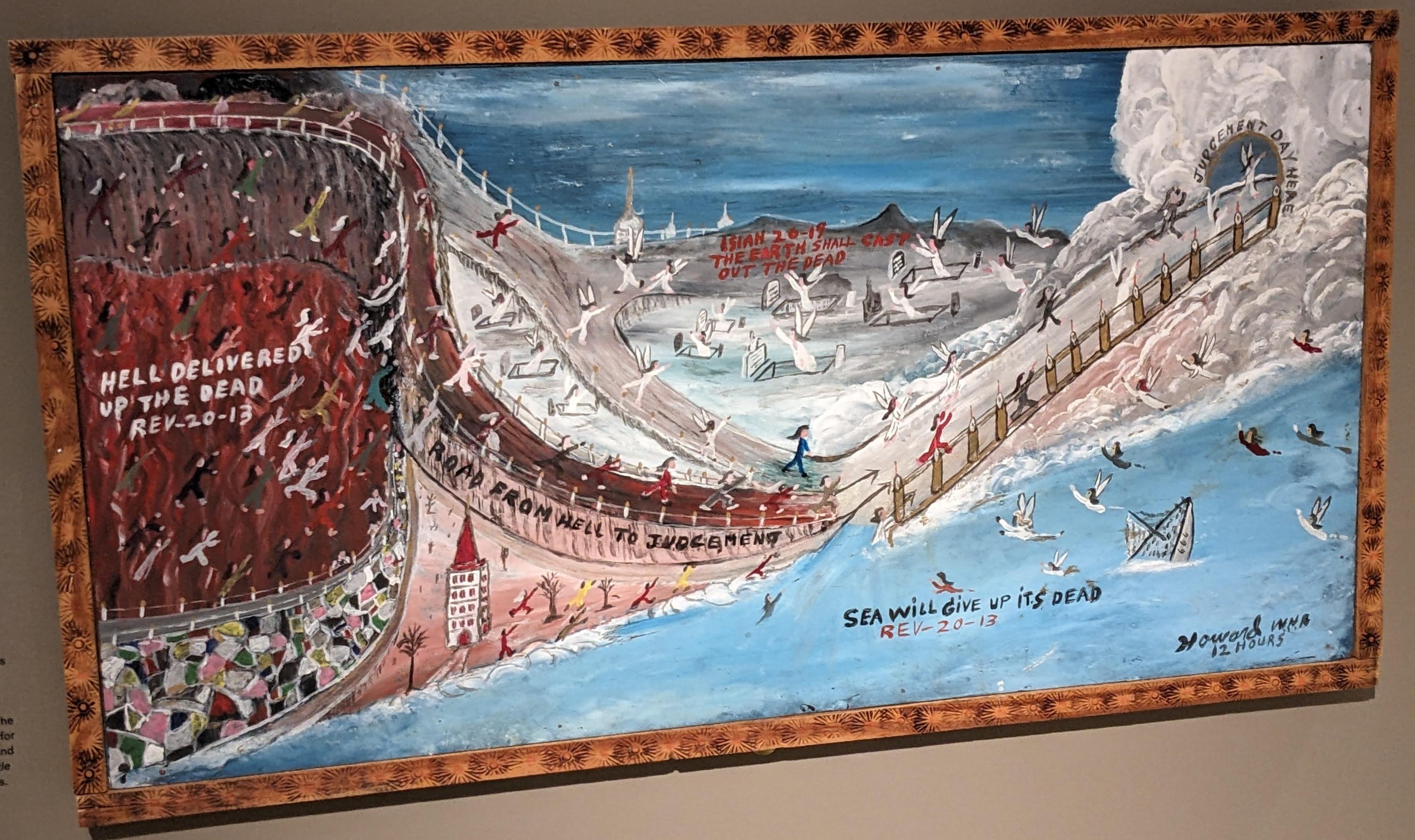
Howard Finster, “Sea Will Give Up Its Dead” (1977) (See more of Finster’s work here.)
This is the kind of Christianity that one finds it in the poetry of Emily Dickinson, as in this composition for her nephew, Ned:
The Bible is an antique Volume -
Written by faded Men
At the suggestion of Holy Spectres -
Subjects - Bethlehem -
Eden - the ancient Homestead -
Satan - the Brigadier -
Judas - the Great Defaulter -
David - the Troubadour -
Sin - a distinguished Precipice
Others must resist -
Boys that "believe" are very lonesome -
Other Boys are "lost" -
Had but the Tale a warbling Teller -
All the Boys would come -
Orpheus' Sermon captivated -
It did not condemn -
(Nothing to do with this blog post, but for a fascinating and salacious piece of historical sleuthing related to the Dickinson household, see this article…)
It is also the kind of Christianity that the musicologist Tim Eriksen is working to preserve, performing songs from the Sacred Harp and New England gospel traditions. Below are a few excerpts from his recordings, and the corresponding texts from eighteenth- and nineteenth-century hymnals:
My favorite Christmas carol was written by the Native American minister Samson Occom (who makes a cameo appearance in Adam Nelson’s new book on Dartmouth v. Woodward, which I also read last week!)
Samson Occom, “O, Sight of Anguish” (1751)
O sight of Anguish, view it near
What weeping innocence is here
A manger for his bed.
The brutes yield refuge to his woe;
The worse brutes no pity show,
Nor give him friendly aid.
Say, radiant seraphs thron’d in light,
Did love o’er tow’r so high a flight?
Or glory sink so low?
This wonder angels scarce declare
Angels the rapture scarce can bear,
Or equal praise bestow.
Redemption! tis a boundless theme!
Thou boundless mind our hearts inflame
With ardor from above.
Words are but faint, let joy express,
Vain is mere joy, let actions bless
This prodigy of love.
(The other Nativity poem that perfectly captures the Christian message is William Blake’s “On Another’s Sorrow.”)
Asa Abel, “I Love the Holy Son of God” (1837)
The sun would not behold the scene,
But round Him threw night’s sable screen;
Nature was robed in mourning mien,
And sighed when Jesus suffered.
But ah! His persecutors stood,
Reviling Christ, the Son of God,
Unmoved to see His gushing blood,
And shocking insults offered.
O! why did not His fury burn,
And floods of vengeance on them turn?
Amazing! See, His bowels yearn
In soft compassion on them.
No fury kindles in His eyes,
They beam with love—and when He dies,
“Father, forgive,” the sufferer cries,
“They know not!”—O forgive them.
How ardent ought my love to be
To Him who’s done so much for me;
My constant service, faithful, free—
And all my powers employing.
I should my cross with pleasure bear,
And place my all of glorying there,
In His reproach most gladly share,
In tribulation joying.
Friendship, to ev’ry willing mind,
Opens a heav’nly treasure,
There may the sons of sorrow find
Sources of lasting pleasure;
See what employments men pursue,
Then you will own my words are true,
Friendship alone presents to view
Sources of lasting pleasure.
Poor are the joys that fools esteem,
Fading and transitory;
Mirth is as fleeting as a dream
Or a deluding story.
Luxury leaves a sting behind,
Wounding the body and the mind;
Only in friendship can we find
Pleasure and solid glory.
Happy the man that hath a friend
Formed by the God of nature;
Well may he feel and recommend
Friendship for his Creator;
Then let our hearts in friendship join
To let our social pow’rs combine,
Ruled by a passion most divine,
Friendship to our Creator.
Thomas More, “Thou Only Solace in Sorrow” (1854)
O thou who driest the mourner’s tear!
How dark this world would be
If, pierced by sin and sorrow here,
We could not fly to thee!
The friends who in our sunshine live
When winter comes are flown,
And he who has but tears to give
Must weep those tears alone.
O, who would bear life’s stormy doom,
Did not thy wing of love
Come, brightly wafting through the gloom
Our peace-branch from above?
Each sorrow, touched by thee, grows bright
With more than rapture’s ray,
As darkness shows us worlds of light
We never saw by day.
Of course, I have no expectation that Americans will (or should) all be singing from the same hymnal, but it would be nice if, while searching for sources of shared identity, we took seriously the sources of beauty and commitment in the past. And doing so means reckoning with Protestant prophecy and poetics.
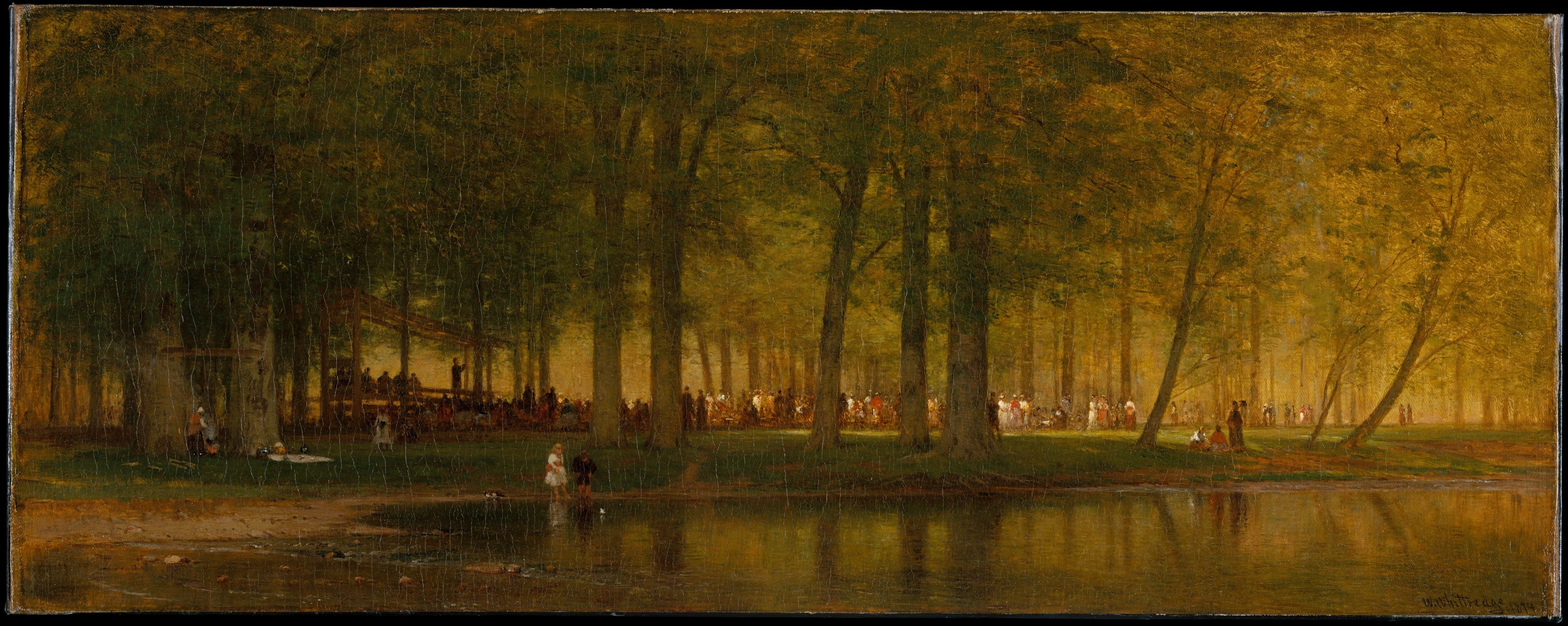
Thomas Worthington Whittredge, “The Camp Meeting” (1874)